Showing posts with label Pune. Show all posts

Thursday, February 16, 2012

Pune 2012 — Bobby Clennell

My youngest son Jake and I arrived in Pune on Wednesday 1st February at around 4 am. I attended a 9.30 am Women’s class taught by Guruji and Abhijata. It was a special “jet lag class”. We began with some supported inversions, some of which I had never seen done in quite the same way before. This is my 19th trip to Pune — the first was in 1976 — and I don’t know why I am surprised that they are still coming up with new material!

Viparita Karani/Sirsasana: Sit backwards on a chair with the knees bent over the back of the chair rest. Slide back off chair and place the crown of the head on a vertical bolster. Thread your arms through the chair and hold the back legs. There was much emphasis on lifting through the dorsal spine.

Viparita Dandasana: Sit backwards through the chair. Curve back around the chair seat. Support top of the back of your head on a vertical bolster, and your feet on blocks. Hold the back legs of the chair.

Viparita Karani/Sarvangasana: Proceed as for chair Sarvangasana, with your shoulders resting on a horizontal bolster and the back of the head on the floor, but rather than extending your legs out, bend them over the back of the chair rest. As for regular chair Sarvangasana, there was lots of lifting through the dorsal spine.

Setu Bandasana. Sit backward through the chair. Keeping your knees bent, slide back off the edge of the chair and place the back of your head on a vertical bolster (build up the height of the bolster as needed).

Then, just when you thought that this was going to be a restorative class, we went straight into some simple, but extremely vigorous standing poses (including lots of Adho Mukha Svanasana).

This class was just what was needed to throw off the fatigue and fuzzy-headedness of the journey.

Geetaji taught pranayama on Thursday and standing poses on Friday — fabulous classes both of course. Guruji and Abhyjata taught Saturday’s women’s class, and it reminded me of Guruji’s classes in the 70s. This was a “remembering–what–it’s–like–to–be–taught–by–a–master” sort of a class. There’s just no other way of putting it!

Maty Ezraty doing Pincha Myorasana in the practice session


Mary Reilly in the practice room

One evening a few of us attended a Sufi music festival. Parvathy Bauul from the Bauul sect was the last act. She chanted and danced, and twirled, causing her hem length dreadlocks to swing and flare out like a mandala. It was all meditation for her and a part of her practice. Here is a clip of her from You Tube, although you lose much of the electrifying affect that you get when she is right there in front of you.

Bauul is the equivalent of Sufi in India, particularly in Bengal, where Parvathy comes from. Her impressive beauty, her personality and the intensity of her devotional chanting and rotating dance, Dervish style, make her unique. I will never forget her, or that class with Guruji and Abhyjata.

Guruji then left with Abhyjata and a group of students and teachers for a yoga convention in Bangalore. It had been fascinating watching him in the practice room each morning, coaching his students for a yoga demonstration that they were putting on at the convention.

On Tuesday (almost one week into the course) Prashant taught a class “for the mind”. About half way through the class he directed us through some nostril breathing as we practiced standing poses. Sounds fairly ordinary I know, but taught by Prashantji, it was profound. It was after that class that I finally shook off my jet lag and slept through the night.

With Guruji gone (and also Geetaji, who had gone to Calcutta for another yoga convention), we were left in the good hands of three truly excellent Instiute teachers, Navaz Kamdin, Rajlaxmi, and Gulnaas, and later, when Guruji and his entourage returned, Abhijata Iyengar and Raya Ud also taught.

Last night Prashantji taught a challenging back bends class. The sequence included: Padmasana/Setu Bandasana over a block, and Padmasana/Viparita Dandasana on a chair, Ustrasana, and Viparita Dandasana from the ropes. The objective was to come out of the class feeling as cool and calm (Prashantji used the word “sanctified”) as we had after his forward bend class “for the mind”.

This morning, Guruji taught a truly profound and masterful class with Abhyjata. We came onto the points of the fingers whenever the hand was on the floor (Parivrtta Ardha Chandrasana, a version of Virabadrasana III with hands on the floor in frount of us, and Bharadvajasana I: “tiger claws”!).

We are exactly at the halfway point of the month.

Richard Jonas

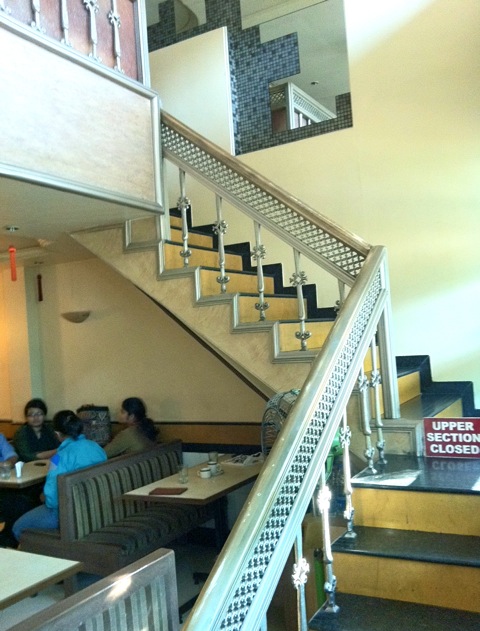
I love Sunday mornings on Model Colony. There is no traffic. Everything is quiet. I stroll down to the neighborhood café, Lalit Mahal, for breakfast: upma and real coffee. The owner was starting the day with a puja for his garlanded deity, and the fragrance of incense permeates the entire place.

Puja

Interior of the Lalite Mahal


Monday, February 8, 2010

Richard Jonas

Each morning in the Asana Hall Guruji works with his granddaughter Abhi, imparting insights and wisdom to another generation – and to those of us who gather around to watch and listen. He has Abhi and a student stand side by side, then asks Ray, a medical doctor from New York, to observe as the two do Samasthiti, then Utkatasana Whose legs are long in the front, Guruji asks, whose long in the back? Is the skin on their thighs moving up or moving down? And can any of the doctor’s sophisticated instruments measure this? No, the doctor admits. Guruji smiles.

Next he tells us that one of the assistants, Raya, is also a musician. At Guruji’s direction, Raya does Trikonasana. Now feel the vibration in your front leg, Guruji tells him. Raya nods. Is it the same as the vibration in your back leg? No, Raya says. Guruji has Raya take his back leg further back, then re-establish the pose. Now how is the vibration? he asks. Raya nods. It is in tune. Guruji laughs. Raya makes music with an instrument, he says, but I use the body as the instrument, and I bring it into tune.

Guruji has Raya take Utthita Parsvakonasana, as more students gather. Is there vibration in this leg? Guruji asks, touching the back one. Yes, Raya says. But not in this leg, the front? he asks. No. That’s because the back leg is longer, Guruji says, having Raya move deeper into the bend, coming lower. Now is there a vibration in the front leg too? especially the outer thigh? Yes, Raya says, noticeably straining after his long time in the posture. That is how I make music with the body, Guruji says.

In Wednesday’s Ladies Class, which I observe, Geetaji talks, movingly and profoundly, about aging. When one is young, she says, one can do; when she was young, she easily did this or that asana or part of the asana – for example, taking the mid-buttock deeply in, in standing postures and backbends, as she is teaching today. Then it came without thinking, she says. It is not that she has just discovered these points that she is teaching now; it is that, with an older body, one has to work differently, with more awareness and intelligence. This is how she does her asanas now, she says, and this is the answer to the questions we ask her: How can I do? What should I do when This bothers me, or That pains me?

In another class we spend a long time preparing the arms for Virabhadrasana I and III. Afterwards we stand again, arms in Urdhva Namaskarasana. Take the arms back, Geeta says, back behind the ears! Elbows straight! Shoulders and trapezius back! Armpit chest open! Back ribs in! Make the arms a window for the head!

Now, where is the opening? Where does the breath go? she asks, as mine floods the sides of my chest. I have given you these external points so you can find the openness inside, she tells us.

Prashant talks about learning to be a student. We can – many people do – do yoga to perform, to show off, to be fit, to have a “lens perfect” pose, he says. Or we can develop a learner’s culture, studying the body, the mind, the breath, the effect they have on one another. In these subtle, inward dynamics we will find yoga, he says, and only there.

A sizeable New York contingent is here, Bobby Clennell, Michelle LaRue, Tamar Kelly and myself from the Iyengar Institute staff, plus Nikki Costello, Sheila Bunnell, Cheryl Malter, Barbara Boris and Martin Brading. Senior Teacher Mary Reilly taught a workshop at the Institute just before coming to Pune; Senior Teachers Judy Brick Freedman, Chris Saudek, who taught at last year’s Mary Dunn Weekend, and Anna Delury, who joined us for Mary’s memorial service, are here too.

You see them and others in the practice hall, at lunch and dinner, walking around, but not, this year, at the internet café near the Ambience Hotel. That is closed. More people have wifi in their apartments now; others find somewhere else from which to write home and hear news of blizzards and record cold in New York. Pune is clear-sunny and warm, not too hot yet. The pollution seems no worse but traffic is a chaos of bicycles, rickshaws, motorcycles, more and more cars, especially on the FC and JM roads, newly made one-way. It will be months, the Times of India says, before the city installs pedestrian crossings. Big banners at Pune Central, the giant shopping complex almost across the street from the Institute, offer “51 Percent Off Happiness.”

My friend Eric, who lives in Pune, picks me up on his new motorcycle, and we ride to the 8th-century rock-cut temple of Pataleshwar Caves, to a park, to the river, to street stands for ice cream, spooning out tastes for the little boys who stand pulling at our sleeves, motioning piteously to their mouths, holding up their little bowls.

From the first, practice at R.I.M.Y.I. seems involving, grounded, soaring. After the sustained hard work of the standing poses in Geeta’s class, it is wonderfully quiet and restful to be in Sirsasana, one tall tree among a forest, undisturbed by the slight stir of the ceiling fan.

The sky is black when I leave in the morning, still dark when I arrive early for the 7:00 class. A dozen people are lying down or working at the ropes. The Asana Hall is not yet lit, but at the window, from across the small courtyard, comes a light from Guruji’s room, where he sits at his desk. Another day in Pune begins.