March 5, 2012:
This week forty students from China have arrived at the Institute to be trained under the guidance of the Iyengars. The first class taught by Prashant was very interesting. The hall was packed, and a translator followed Prashant's steps while the students quietly followed the directions. Prashant was very patient and used several analogies to Buddha and Lao-Tze, establishing a warm welcoming feeling throughout the room. Following the class Pandu came in and held an informal orientation meeting. Meanwhile Guruji arrived and greeted them warmly. He then proceeded to his daily practice and teachings to Abhijata and a few lucky bodies.
In the evening Geeta came in and divided the group, having the old students on one side and the Chinese on the other. She also instructed the translator to sit next to her. She was very methodical as some of the students are raw beginners. It was basically a level 1 class, but with Geetaji being very demanding on all levels. One member of the Chinese group was wearing a Shiva T-shirt. Geeta kept calling him Shiva and making remarks such as you should not make the mistake of wearing Shiva's shirt. She was very amusing and very patient throughout the evening. She taught the action of Adho Mukha Upavista Konasana to one of them who was overly flexible (her chest was flat on the ground, but the legs were rolling in). An assistant had her hands on the back of the outer thighs to provide resistance, as the trunk extended forward to adho mukha upavista konasana.
March 7, 2012:
Today the women's class was taught by Abijhata alone as Guruji was in Mumbai to attend a celebration event on behalf of one of the old yoga schools. As in Geetaji's class, the class was tailored to level one, consisting of the standing postures being methodically taught and held. There was no sirsasana, only sarvangasana and setubandha on a bench for the special needs. In the end of sarvangasana some of them were complaining about neck pain and she promptly had them sitting in svastikasana, turning the head from right to the left and vice versa, followed by adho mukha svastikasana,and parivrtta svastikasana. She then asked: Is the pain gone? And most nodded yes. The teaching was excellent, sharp, precise, and clear with not too many words.
*There will be no personal practice on Mondays and Wednesdays throughout the month as the hall will be used to train the Chinese group.
March 11, 2012:
Today is Sunday and as part of the ritual over the years, I observed the children's class. The auspicious surprise was when Geeta came in the beginning of it addressing corrections, basically taking over the teachings. The whole atmosphere was transformed, even the little ones were following the clear directions and were able to stand still with the full extension of the limbs in Tadasana, urdhva hastasana and several turns of adho mukha svanasana, and virabhadrasana 3.
Some highlights of it:
Urdhva Hastasana to Urdhva Prasarita Ekapadasana, arms in urdhva hastasana are straight and legs in urdhva prasaritta ekapadasana are straight. If the arms are not straight in Urdhva Hastasana, the leg will not go up. The whole body has to work. The arms are up and straight, the leg is up and straight. Do this 3 times with the same leg(motion) then change legs. Synchronize the action.
She commented: I NEVER THOUGHT YOU WOULD HAVE SO MUCH FEAR INSIDE. CHILDREN SHOULD NOT HAVE FEAR.
SOME OF YOU ARE NOT DOING WHAT THE TEACHER IS SAYING.
Virabhadrasana 3: From the arm pit the arms and elbows are straight. The arms in virabhadrasana 3 are like in urdhva hastasana, arms and elbows straight.
Why do you clinch your teeth? Don't do that.
Repeat Virabhadrasana 3.
Those who fell to straighten the arm pit, they lost their balance. The balance is related to the arm pit extension.
Tadasana: Chest forward and shoulders back. In Yoga you have to be strong. The shouders are back, and the chest is forward.
Repeat Virabhadrasana 3. Synchronize the actions, shoulders back,chest forward, hands forward, trunk forward, all have to synchronize.
There were not so much motion as usual, but a few basic asanas emphasizing the extension of the limbs and lift of the chest. The class ended at 9:00am and was followed by the senior students' bash ( some of them are to become teachers).
A few highlights of the senior class consisted of: adho mukha svanasana, uttitha hasta padangusthasna 1(holding the foot) and 3 with the instructions to become tall. The trunk and the lifted leg straight are synchronized. The buttocks are sharp and the chest is up. Followed by ubaia padangusthasana with the instruction of the back lift synchronizing with the abdominal grip, and the balance on the buttocks. Krounchasana with the femur into the socket and the back of the thighs opened. The lower back should not fall. Open the back of the knees and thighs so hamstrings will not break.
Twists ending in marichyasana IV, the heel of the padmasana foot are in line with the navel and the toes are sharp on the root of the thighs. Use a blanket under the marychiasana leg for the padmasna leg to go lower . For stiffness, from dandasana sit straight with both shoulders back and open first the padmasana leg to the side, turn the padmasana leg out (decentralize it). This goes for arkana dhanurasana the knee and thigh have to go back. Followed by Kapilasana(bolster for the back), yoga nidrasana, and ending in supta padangusthasana.
March 12, 2012:
Women's class conducted by Abijatha under the guidance of Guruji. The standing postures being emphasized and taught methodically.
As there was no personal practice, just a few of us teachers and a couple of senior teachers were there. We all witnessed the fascinating class being guided by Guruji. In the end we helped with a few adjustments in sirsasana and setting up the special need group for bench setubandha.
March 14, 2012:
Women's class with the Chinese group class taught by Raia via Guruji.
The westerners moved to the Patanjali's side and Chinese by the props so Guruji could address the corrections.
Standing postures
March 16, 2012: Geetaji's Class
The entire class was devoted to how to use the ropes in their proper sequence. Geeta methodically introduced the various stages from rope 1, building to subsequent, more advanced stages. Because the restrictions of the ropes and the large group, we spend the entire class learning the ropes. We finished in brick setubandha.
March 17, 2012:
Class taught by Abijatha through Guruji. Revision from the previous classes
The sequence consisted of standing postures, twists, followed by sirsasana. In sirsasana, Guruji corrected several times the action of interlocking the fingers. Guruji says that the thumbs do not cross, that is for old people, also he told everyone to bring the legs away from the wall and attempt the balance. After that a sequence of back extension urdhva mukha svanasana,salabasana, dhanurasana, ustrasana, and urdhva dhanurasana on a setubandha bench with a bolster and 2 people sharing the bench. The bolster was used to give a horizontal support for middle of the back (not pelvis).
Sarvangasana with 4 mats, followed by uttanasana and supported paschimottanasana (sited on the sarvangasana mats). End of the class.
March 18, 2012: q/a from the Chinese to Guruji only. This has been video by Jay. In the evening there was the monthly lecture on the Bhagavad-Gita chapter 13 conducted by Geeta.
March 19, 2012: Class conducted by Abijatha and Guruji.
March 21, 2012: Class conducted by Abijatha and Guruji
March 22, 2012: Geeta's pranayama. The class consited of unsupported savasana, ujjayi, viloma, and gentle antara/bahya kumbhaka. Throughout the class there were long interruptions with a masterful teaching on how to see the subtle imbalances and choosing a couple of the students to correct. How to observe and break old habits such as the habitual way to cross the legs, and positioning the feet. She emphasized the importance to learn the asanas before pranayama to understand the gross alignment before addressing the subtle alignment of both sides and their correspondent nadhis(ida and pingala). She then had a brief q/a from the group.
March 23, 2012: Today is a celebration of Gudi Padva to mark the Marathi New Year in India. The New Year is celebrated only in the Maharashtra region. The institute is closed but there will be a celebration and an award for Guruji on behalf of his overall contribution to humanity. The event will take place at 5pm by the Aditya Pratishthan. Although most of the evening was spoken in marathi, Guruji eloquently spoke in English, giving us a taste of his life in Pune, and the depth of his system based on the embodiment of Patanjali Yoga Sutras. This has been filmed and hopefully will be shown.
It has been an auspicious experience to be part of this schedule and valuable learning being passed from the generations. It seems that a new generation is following the natural order of evolution, yet maintaining the roots and essence of the tradition as transmitted from Guruji. To be under his fiery teachings has been pure bliss and blessings.
Marcia Monroe
Thursday, March 29, 2012

Saturday, March 3, 2012
Blog On, by Richard Jonas
On the day I arrived in Pune the constructions gang began tearing up the road at the Toyota Chowk, then snaking their was along Lakaki Road, right-angling into our apartment parking lot and directly under our windows. The first step involved pick-axing, the next, jackhammers; the small but upright and strong-looking women seemed to do most of the work, including hoisting big disc-like metal containers full of rocks up and onto their heads to be carried away. The men helped a bit, and whole families, including very little children, would watch the work, which was signposted as the installation of a new natural gas pipeline, to reduce pollution in Pune (at once a worthy cause and a long shot). Throughout the length of our road there were piles of small, jagged rocks, and the already heavily-trafficked street became that much narrower, with two lanes of bicycles, scooters, rickshaws and cars jostling against pedestrians, pushed in off the sidewalks. With an odd feeling of completion and full-circle, the building caste members were back at work at the Chowk today, setting right what they’d begun tearing up a month ago.
The beginning of February brought a record-setting cold snap, but this week’s afternoons set new statistics for heat. Guruji is on fire too, sending students in the Ladies’ Class up into 14 long Urdhva Dhanurasanas, all the lift from the deltoids, the hip sockets, the skin of the thighs. Guruji’s eyes flash fire. Don’t let them come down until you say so, he tells his granddaughter Abhijata, who does most of the actual talking, acting as intermediary between the students and Guruji. He observes her, and them, from his perch, upside down on the trestler, and sometimes she holds the microphone up to him. “Don’t do your old pose!” he insists, “create a new sanskara.” Replaying the class myself when I practice that afternoon in my flat, I do the 14 backbends, trying to rekindle Guruji’s fiery intensity; others say they counted 25; everyone is happy and shaky-legged after the class.
Geetaji, back from Calcutta, teaches magnificent backbends herself on Monday night; I end up in the front row, my head to the platform, near her feet and warmed by her presence. Her directions are so precise, so just-right, that I do some of my best work ever.
Abhi, marshaling the last bit of their strength for backbends, reminded the Ladies’ Class students that next day Pranayama was to begin so they should give it their all, and indeed the Pranayama is, as always, the nectar of our time here. Prashant teaches a morning class beautiful for its thoughtful, thought-provoking nature. The ears, he reminds us, are the highest of the senses; knowledge passed through them, the highest form of knowledge; and we work to sanctify our own. The “tender exhalations” with which we finish are deeply quiet and beautiful.
Geetaji talks about the end of life; she used to leave the stage, walk around, move everyone’s body, showing them the correct way to do the asanas, she says; now she can’t do it anymore, and we must learn to “set right” ourselves.
Raya, the favored assistant, runs at full speed the length of the Asana Hall, holding a heavy teak Viparita Dandasana Bench high above his head, arms straight -- elbows locked. He leaps over the bodies of prone Westerners like Hanuman, making his leap from Ceylon to India.
Jake Clennell shows us a clip from his upcoming film, Guruji. Much of it was filmed last year, but in the Asana Hall here, and during Guruji’s teaching at the conference in Bangalore, Jake has added new footage to refine and amplify the story, not just a biography of B. K. S. Iyengar, but an exploration of his impact on many students, an exploration of the nature of yoga itself.
The rickshaw drivers go on strike from noon to 5 on Saturday, a particularly busy time as R.I.M.Y.I. students leave Ladies’ Class heading to Roopauli or Vaishali for lunch. Don’t go far, a friendly rick driver tells us, or you may get stuck there; don’t take a ride from a “scab” driver, or you may be the target of violence.
People have begun to leave, our month in Pune having, unbelievably, sped away; some are already gone, and the competition for space in classes is less pressing. Some of the best, though, comes last.
Geetaji teaches a beautiful Pranayama, having us lift our center chest up and hold it there with a back-to-front action; the top chest becomes a mountain, the slightly receded navel, a valley. In lifting our chests, we were lifting up our consciences – higher than consciousness, she said, the highest part of us, what separates us from the animals. And if one holds it up and steady, no thoughts will come.
I am fortunate to be in a small group talking to Prashant, who is generous, eloquent, charming. The asanas are an academy for mind-making,” he told us. “When you are connected in that embodiment you have different potentials.” He was asked about meditation. “To be in a sublime thought process: that is meditation. If you are absorbed in natural beauty, you experience this – and are steady.” One should choose to meditate on nature, on a noble ideal or on a religious ideal, he said. “You have to create an ambience or atmosphere so the mind will be quiet. Don’t try to meditate, and then try to quiet the mind.”
The beginning of February brought a record-setting cold snap, but this week’s afternoons set new statistics for heat. Guruji is on fire too, sending students in the Ladies’ Class up into 14 long Urdhva Dhanurasanas, all the lift from the deltoids, the hip sockets, the skin of the thighs. Guruji’s eyes flash fire. Don’t let them come down until you say so, he tells his granddaughter Abhijata, who does most of the actual talking, acting as intermediary between the students and Guruji. He observes her, and them, from his perch, upside down on the trestler, and sometimes she holds the microphone up to him. “Don’t do your old pose!” he insists, “create a new sanskara.” Replaying the class myself when I practice that afternoon in my flat, I do the 14 backbends, trying to rekindle Guruji’s fiery intensity; others say they counted 25; everyone is happy and shaky-legged after the class.
Geetaji, back from Calcutta, teaches magnificent backbends herself on Monday night; I end up in the front row, my head to the platform, near her feet and warmed by her presence. Her directions are so precise, so just-right, that I do some of my best work ever.
Abhi, marshaling the last bit of their strength for backbends, reminded the Ladies’ Class students that next day Pranayama was to begin so they should give it their all, and indeed the Pranayama is, as always, the nectar of our time here. Prashant teaches a morning class beautiful for its thoughtful, thought-provoking nature. The ears, he reminds us, are the highest of the senses; knowledge passed through them, the highest form of knowledge; and we work to sanctify our own. The “tender exhalations” with which we finish are deeply quiet and beautiful.
Geetaji talks about the end of life; she used to leave the stage, walk around, move everyone’s body, showing them the correct way to do the asanas, she says; now she can’t do it anymore, and we must learn to “set right” ourselves.
Raya, the favored assistant, runs at full speed the length of the Asana Hall, holding a heavy teak Viparita Dandasana Bench high above his head, arms straight -- elbows locked. He leaps over the bodies of prone Westerners like Hanuman, making his leap from Ceylon to India.
Jake Clennell shows us a clip from his upcoming film, Guruji. Much of it was filmed last year, but in the Asana Hall here, and during Guruji’s teaching at the conference in Bangalore, Jake has added new footage to refine and amplify the story, not just a biography of B. K. S. Iyengar, but an exploration of his impact on many students, an exploration of the nature of yoga itself.
The rickshaw drivers go on strike from noon to 5 on Saturday, a particularly busy time as R.I.M.Y.I. students leave Ladies’ Class heading to Roopauli or Vaishali for lunch. Don’t go far, a friendly rick driver tells us, or you may get stuck there; don’t take a ride from a “scab” driver, or you may be the target of violence.
People have begun to leave, our month in Pune having, unbelievably, sped away; some are already gone, and the competition for space in classes is less pressing. Some of the best, though, comes last.
Geetaji teaches a beautiful Pranayama, having us lift our center chest up and hold it there with a back-to-front action; the top chest becomes a mountain, the slightly receded navel, a valley. In lifting our chests, we were lifting up our consciences – higher than consciousness, she said, the highest part of us, what separates us from the animals. And if one holds it up and steady, no thoughts will come.
I am fortunate to be in a small group talking to Prashant, who is generous, eloquent, charming. The asanas are an academy for mind-making,” he told us. “When you are connected in that embodiment you have different potentials.” He was asked about meditation. “To be in a sublime thought process: that is meditation. If you are absorbed in natural beauty, you experience this – and are steady.” One should choose to meditate on nature, on a noble ideal or on a religious ideal, he said. “You have to create an ambience or atmosphere so the mind will be quiet. Don’t try to meditate, and then try to quiet the mind.”
Tuesday, February 21, 2012
Thursday, February 16, 2012
Pune 2012 — Bobby Clennell
My youngest son Jake and I arrived in Pune on Wednesday 1st February at around 4 am. I attended a 9.30 am Women’s class taught by Guruji and Abhijata. It was a special “jet lag class”. We began with some supported inversions, some of which I had never seen done in quite the same way before. This is my 19th trip to Pune — the first was in 1976 — and I don’t know why I am surprised that they are still coming up with new material!
Viparita Karani/Sirsasana: Sit backwards on a chair with the knees bent over the back of the chair rest. Slide back off chair and place the crown of the head on a vertical bolster. Thread your arms through the chair and hold the back legs. There was much emphasis on lifting through the dorsal spine.
Viparita Dandasana: Sit backwards through the chair. Curve back around the chair seat. Support top of the back of your head on a vertical bolster, and your feet on blocks. Hold the back legs of the chair.
Viparita Karani/Sarvangasana: Proceed as for chair Sarvangasana, with your shoulders resting on a horizontal bolster and the back of the head on the floor, but rather than extending your legs out, bend them over the back of the chair rest. As for regular chair Sarvangasana, there was lots of lifting through the dorsal spine.
Setu Bandasana. Sit backward through the chair. Keeping your knees bent, slide back off the edge of the chair and place the back of your head on a vertical bolster (build up the height of the bolster as needed).
Then, just when you thought that this was going to be a restorative class, we went straight into some simple, but extremely vigorous standing poses (including lots of Adho Mukha Svanasana).
This class was just what was needed to throw off the fatigue and fuzzy-headedness of the journey.
Geetaji taught pranayama on Thursday and standing poses on Friday — fabulous classes both of course. Guruji and Abhyjata taught Saturday’s women’s class, and it reminded me of Guruji’s classes in the 70s. This was a “remembering–what–it’s–like–to–be–taught–by–a–master” sort of a class. There’s just no other way of putting it!

Maty Ezraty doing Pincha Myorasana in the practice session

Mary Reilly in the practice room
One evening a few of us attended a Sufi music festival. Parvathy Bauul from the Bauul sect was the last act. She chanted and danced, and twirled, causing her hem length dreadlocks to swing and flare out like a mandala. It was all meditation for her and a part of her practice. Here is a clip of her from You Tube, although you lose much of the electrifying affect that you get when she is right there in front of you.
Bauul is the equivalent of Sufi in India, particularly in Bengal, where Parvathy comes from. Her impressive beauty, her personality and the intensity of her devotional chanting and rotating dance, Dervish style, make her unique. I will never forget her, or that class with Guruji and Abhyjata.
Guruji then left with Abhyjata and a group of students and teachers for a yoga convention in Bangalore. It had been fascinating watching him in the practice room each morning, coaching his students for a yoga demonstration that they were putting on at the convention.
On Tuesday (almost one week into the course) Prashant taught a class “for the mind”. About half way through the class he directed us through some nostril breathing as we practiced standing poses. Sounds fairly ordinary I know, but taught by Prashantji, it was profound. It was after that class that I finally shook off my jet lag and slept through the night.
With Guruji gone (and also Geetaji, who had gone to Calcutta for another yoga convention), we were left in the good hands of three truly excellent Instiute teachers, Navaz Kamdin, Rajlaxmi, and Gulnaas, and later, when Guruji and his entourage returned, Abhijata Iyengar and Raya Ud also taught.
Last night Prashantji taught a challenging back bends class. The sequence included: Padmasana/Setu Bandasana over a block, and Padmasana/Viparita Dandasana on a chair, Ustrasana, and Viparita Dandasana from the ropes. The objective was to come out of the class feeling as cool and calm (Prashantji used the word “sanctified”) as we had after his forward bend class “for the mind”.
This morning, Guruji taught a truly profound and masterful class with Abhyjata. We came onto the points of the fingers whenever the hand was on the floor (Parivrtta Ardha Chandrasana, a version of Virabadrasana III with hands on the floor in frount of us, and Bharadvajasana I: “tiger claws”!).
We are exactly at the halfway point of the month.
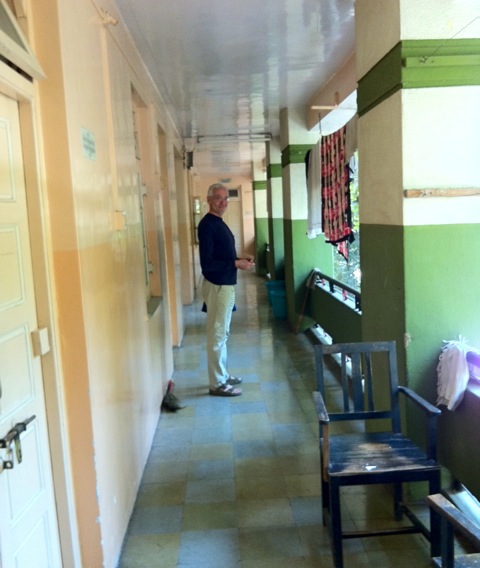
Richard Jonas
I love Sunday mornings on Model Colony. There is no traffic. Everything is quiet. I stroll down to the neighborhood café, Lalit Mahal, for breakfast: upma and real coffee. The owner was starting the day with a puja for his garlanded deity, and the fragrance of incense permeates the entire place.

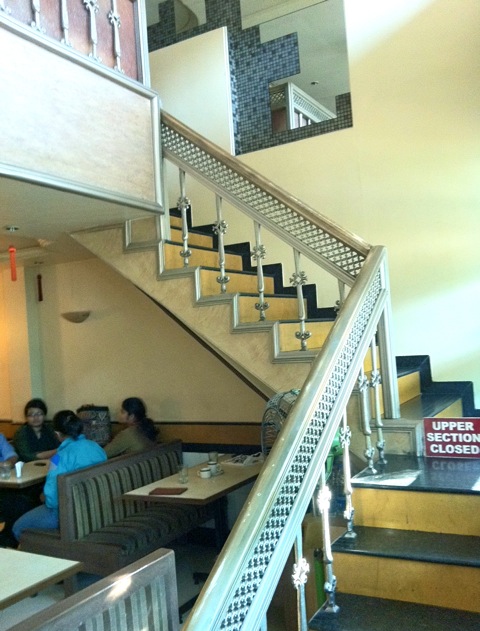
Interior of the Lalite Mahal
Monday, February 13, 2012
Update from Pune, by Richard Jonas
Everyone Emails that New York -- and much of the U.S. -- is unnervingly warm, no winter yet, but Pune’s February is the coldest in a decade, 4 degrees Celsius this morning as I walk to Prashant-ji’s early morning class, the sky still midnight-dark, the white moon overhead as full and bright as when I walked home last night.
The Punites shiver and pile on track jackets, scarves and woolen caps, but by afternoon it is warm and sunny, even clear, it seems, though the pollution is as bad as ever (on our Sunday off, I work from the Lung series in the back of Light on Yoga), the traffic rather worse.
Guruji and Abhijata, Raya and a few others have left for the Health For All International Conference on Yoga, Naturopathy and Aromatherapy Expo in Bangalore. They spent their time in the Asana Hall our first week here readying for a demonstration lecture, which is said to be Guruji’s last public teaching. My first day here was his first back in the Asana Hall in shorts, his wracking cough of last month cleared up, and I am told later that his teaching in Bangalore is energetic and commanding. Geetaji, too, after giving us two brilliant classes, has left for a conference in Calcutta for two weeks, so we are figurative orphans here, left behind, but it is a good chance to study with the Indian assistants, the lesser-known members of the faculty at R.I.M.Y.I. I have taken class with them before, but many of the students know them only from their helpful suggestions during our daily practice sessions.
Geetaji teaches us Virabhadrasana I completely from the shoulder blades – so we do it completely without pushing in at the lumbar. Abhijata taught several times before she left, notably interpreting Guruji during the Ladies’ Classes. In his long, propped backbends and inversions, Guruji talks to her, and she, with all the time more confidence and clarity, as well as her own developing personality and style as a teacher, interprets his words for the students.
Do not do according to convenience, Abhijata instructs. Leave out old ideas – leave out old samskaras. How many of you are open to see that new samskara of Halasana? Use your body as a prop to culture your intelligence.
Nawaz, one of Guruji’s students and teachers for decades, teaches a few classes while the group is gone, quoting “our Guruji” with nearly every instruction; she combines a gentle, motherly manner with demanding, crystal-clear instructions. “Once we understand the proper skeletal-muscular movements of the body, we can never go wrong,” she says.
“Let the breath be the benefit, the benefactor and the beneficiary” in your work, Prashant tells us. If you donate to a generous person, many people benefit as the largesse is passed on; so it is with the breath.
Each in their own way, interpreting Guruji.
I have been working on the Institute Archives, filing slides of the original photos from Light on Yoga which Martin Brading then scans for preservation. I've seen pictures of Guruji doing incredible asanas, meeting with the famous like Pope John XXIII, visiting yoga centers and Institutes around the world, including ours in New York. At another desk, students file letters testifying to the great benefits of Guruji’s work.
There is a big New York contingent in Pune, including Faculty teachers Carrie Owerko, my housemate, Bobby Clennell, Carolyn Christie and me, plus Association teachers Marcia Monroe and Harshad Shah, who has Bobby, Martin, Association member from Woodstock, NY, and me over for a lavish Jain lunch. Also here: Association members Alisa Grifo and filmmaker Jake Clennell, Bobby and Lindsey’s son, who travels to Bangalore to film Guruji’s teaching.
The authorities are on an ‘anti-Encroachment’ drive on Ferguson College Road; a week ago, a big truck came by and sliced off the front porch of Roopali, where we go for upma and chai after 7 a.m. class. Evidently it was projecting into the public right-of-way, but by the next morning they had built it right back up and tables were set up again for breakfast
An election is underway here, as in the U.S., and we come home to handbills stuffed under the door; roving trucks move up and down the streets sending out highly-amplified political announcements in Marathi. -- Richard Jonas
The Punites shiver and pile on track jackets, scarves and woolen caps, but by afternoon it is warm and sunny, even clear, it seems, though the pollution is as bad as ever (on our Sunday off, I work from the Lung series in the back of Light on Yoga), the traffic rather worse.
Guruji and Abhijata, Raya and a few others have left for the Health For All International Conference on Yoga, Naturopathy and Aromatherapy Expo in Bangalore. They spent their time in the Asana Hall our first week here readying for a demonstration lecture, which is said to be Guruji’s last public teaching. My first day here was his first back in the Asana Hall in shorts, his wracking cough of last month cleared up, and I am told later that his teaching in Bangalore is energetic and commanding. Geetaji, too, after giving us two brilliant classes, has left for a conference in Calcutta for two weeks, so we are figurative orphans here, left behind, but it is a good chance to study with the Indian assistants, the lesser-known members of the faculty at R.I.M.Y.I. I have taken class with them before, but many of the students know them only from their helpful suggestions during our daily practice sessions.
Geetaji teaches us Virabhadrasana I completely from the shoulder blades – so we do it completely without pushing in at the lumbar. Abhijata taught several times before she left, notably interpreting Guruji during the Ladies’ Classes. In his long, propped backbends and inversions, Guruji talks to her, and she, with all the time more confidence and clarity, as well as her own developing personality and style as a teacher, interprets his words for the students.
Do not do according to convenience, Abhijata instructs. Leave out old ideas – leave out old samskaras. How many of you are open to see that new samskara of Halasana? Use your body as a prop to culture your intelligence.
Nawaz, one of Guruji’s students and teachers for decades, teaches a few classes while the group is gone, quoting “our Guruji” with nearly every instruction; she combines a gentle, motherly manner with demanding, crystal-clear instructions. “Once we understand the proper skeletal-muscular movements of the body, we can never go wrong,” she says.
“Let the breath be the benefit, the benefactor and the beneficiary” in your work, Prashant tells us. If you donate to a generous person, many people benefit as the largesse is passed on; so it is with the breath.
Each in their own way, interpreting Guruji.
I have been working on the Institute Archives, filing slides of the original photos from Light on Yoga which Martin Brading then scans for preservation. I've seen pictures of Guruji doing incredible asanas, meeting with the famous like Pope John XXIII, visiting yoga centers and Institutes around the world, including ours in New York. At another desk, students file letters testifying to the great benefits of Guruji’s work.
There is a big New York contingent in Pune, including Faculty teachers Carrie Owerko, my housemate, Bobby Clennell, Carolyn Christie and me, plus Association teachers Marcia Monroe and Harshad Shah, who has Bobby, Martin, Association member from Woodstock, NY, and me over for a lavish Jain lunch. Also here: Association members Alisa Grifo and filmmaker Jake Clennell, Bobby and Lindsey’s son, who travels to Bangalore to film Guruji’s teaching.
The authorities are on an ‘anti-Encroachment’ drive on Ferguson College Road; a week ago, a big truck came by and sliced off the front porch of Roopali, where we go for upma and chai after 7 a.m. class. Evidently it was projecting into the public right-of-way, but by the next morning they had built it right back up and tables were set up again for breakfast
An election is underway here, as in the U.S., and we come home to handbills stuffed under the door; roving trucks move up and down the streets sending out highly-amplified political announcements in Marathi. -- Richard Jonas
Monday, January 23, 2012
RIMYI Annual Celebration Day - Jan 2012
Annual Celebration Day
This weekend was the Annual Celebration Day at the RIMYI– really two separate days, starting with a Children’s performance on Saturday evening.
From the moment we arrived at RIMYI we knew it was a special night, as beautiful garlands of flowers were draped high above the front gate. We left our shoes by the entrance and walked on a long red carpet from the gate to the hall entrance. Inside the hall, the platform was transformed to a stage, with evocative sets, lights, microphones, and video cameras all ready.
The room then came to life and was filled with music, dancing, and dramatic performances that were absolutely beautiful! The children were dressed in festive Indian attire. Their dedication showed in flawless memorization, presenting for us a traditional story of Maharashtra (the state in which Pune is located). There were hundreds of spectators and we all sat quite snugly on the floor, sharing mats, blankets, and bolsters. At the end, each child gave her/his name for individual recognition, followed by a long round of applause by the audience!
The festivities continued on Sunday morning, beginning with local students—including three medical practitioners--from the Institute speaking from experience of how their practice of yoga has influenced their professional lives. A foreign student spoke of the healing she’s experienced directly from Guruji, Geeta and Prashant. After a break for chai and cookies, we were treated to an impressive display of authentic Indian music, singing, and dancing began that had everyone swaying and applauding. For many, the highlight of Sunday was a young girl (maybe 9 years old) who hopped up on the platform from the audience – very unassuming in her red shirt, black shorts and two pigtail braids – then took center stage and as the music started, performed a sequence of yoga poses that were amazing! She moved effortlessly from standing poses to backbends, arm balances, inversions and of course performing many while in padmasana! The crowd was in awe of her ability, grace and clear devotion to the practice.
After the performances, a feast of delicious traditional Indian food awaited us outside. It was a beautiful afternoon to meet and mingle with those we rarely have time to speak with in the regular routine of a day.
This morning (Monday), the practice hall was back to normal, but everyone seemed to move at a little different pace – with a bit more awareness, intelligence, and appreciation of this gift we receive by being here this month and experiencing Iyengar Yoga at RIMYI.
Ann McDermott-Kave
Saturday, January 14, 2012
Happy New Year from lucienne
Hi Folks,
I am reading that the last post was entered about a year ago and that there are only a few followers, so go ahead and click on all those keys on your dashboard to befriend others on this blog so that it grows and grows and grows.
I arrived in Pune at the end of last year and spent New Years Day sleeping in my Pune appartment. This is my 4th time, so I know how to 'behave' in the beginning days to allow the system to adjust to everything that is different here. Typically as with all muladhara disturbances in the first days we experienced a flooding kitchen due to a broken sink pipe, a blocked toilet and a complete black-out. Fortunately these were outside obstacles and easily removed as Ganesha was trumpeting in full galore after just being showered with praise and fragrantly flowered into the New Year.
On January 2nd I went to the Institute for practice but before that the HighLight was to wish Guruji my wishes for the New Year and to bow before him, the Greatest Teacher and our Inspiration. Later during practice I heard him cough a lot and realized that he was not well. In the following days he practiced at his house and had to take antibiotics due to a chest infection. Nevertheless, until he could absolutely not, he was practicing with us and showing us to practice even during vyadhi. He was having coughing attacks and had to do simple forward bending over a stool with his forehead resting on a pillow to calm the spasms of the lungs.
It was profound and touching to see this as in everything he does there is a lesson for us. Don't stop your practice, adjust it.
Now he is back, looking good and well-rested. He has been co-teaching with his grand daughter Abhijata and is joyfully teaching/practicing surrounded by his intimate indian clan.
The classes have been energizing even though it is quite busy at this moment. There have been days that there were not enough mats for everyone. (There is a lack of mats in general and I urge all of you to bring your yoga mat and leave it here like we used to. Many mats in the Institute are overused and quite honestly disgusting.)
Most classes are taught by the Iyengars to my delight. To see Geetaji 3 times this week for the general, woman's and Pranayama was amazing. She looks so much better than 2 years ago and her teaching has been no-nonsense: if you are new you go upstairs (beginners studio) and if you are 'stupid' she does not waste her time with you anymore. We are all to be super alert and move fast; instructions are very minimal, poses follow in quick succession and can be challenging and you get to experience a lot when she says nothing and let's you be in the pose.
There is a minimum use of props, both to save time with so many people but also to remove the crutches that people bring to the practice. She allows you to keep practicing part of the pose, like ardha padmasana, if the full pose does not come, but she will move on with the rest of the class to the zenith.
To receive teachings from the masters you have to be practicing for years, no kidding. Geetaji teaches you how to think and where you are lacking in your personal practice. It is that place she is aiming for; she does not teach teachers to teach points so they can teach those points to their students. In fact she mocks with that concept. She teaches us how to look at ourselves in our practice, so from that insight, the teaching should come. She keeps telling us how she was never 'taught' by her father, but that it was by observing him that she learned.
Class with Abhijata has been wonderful; she is very talented, clear and joyful as a teacher and has the ability to switch fluently between being a stately teacher and a humble student during class times. She has been teaching with clear alignment themes that run through the class: the lifting of the back arch in standing poses, the inner thighs and the anterior/posterior tailbone in inversions, the upper knee cap activation and how to lengthen the inner and outer knee ligaments evenly....etc, to name a few. All great things to take you deeper.
Class with Prashant has been the least surprising/changing however brilliant and inspiring as always. He keeps on challenging us to find out what the practice of all these asanas is about. He encourages us to strip of the external layers of perfection of asanas and find the inner perfection by questioning ourselves, by doing poses for different goals, by applying kriyas, bandhas, by breath modifications, timings etc. He is all about the study of the 'embodiment', the YOG, not the yogaaaaaaaaaaah! Yesterday he said that we should practice for 'lifetime contentment'. This is one of the treasures that YOG offers.
Next week is Institute Day.
Namaste to all,
lucienne vidah
....and I would love to share Geetaji's sitting/padma class with you in February at the Institute during the Tuesday Teachers class at 10am. Please check the schedule.
Subscribe to:
Posts (Atom)